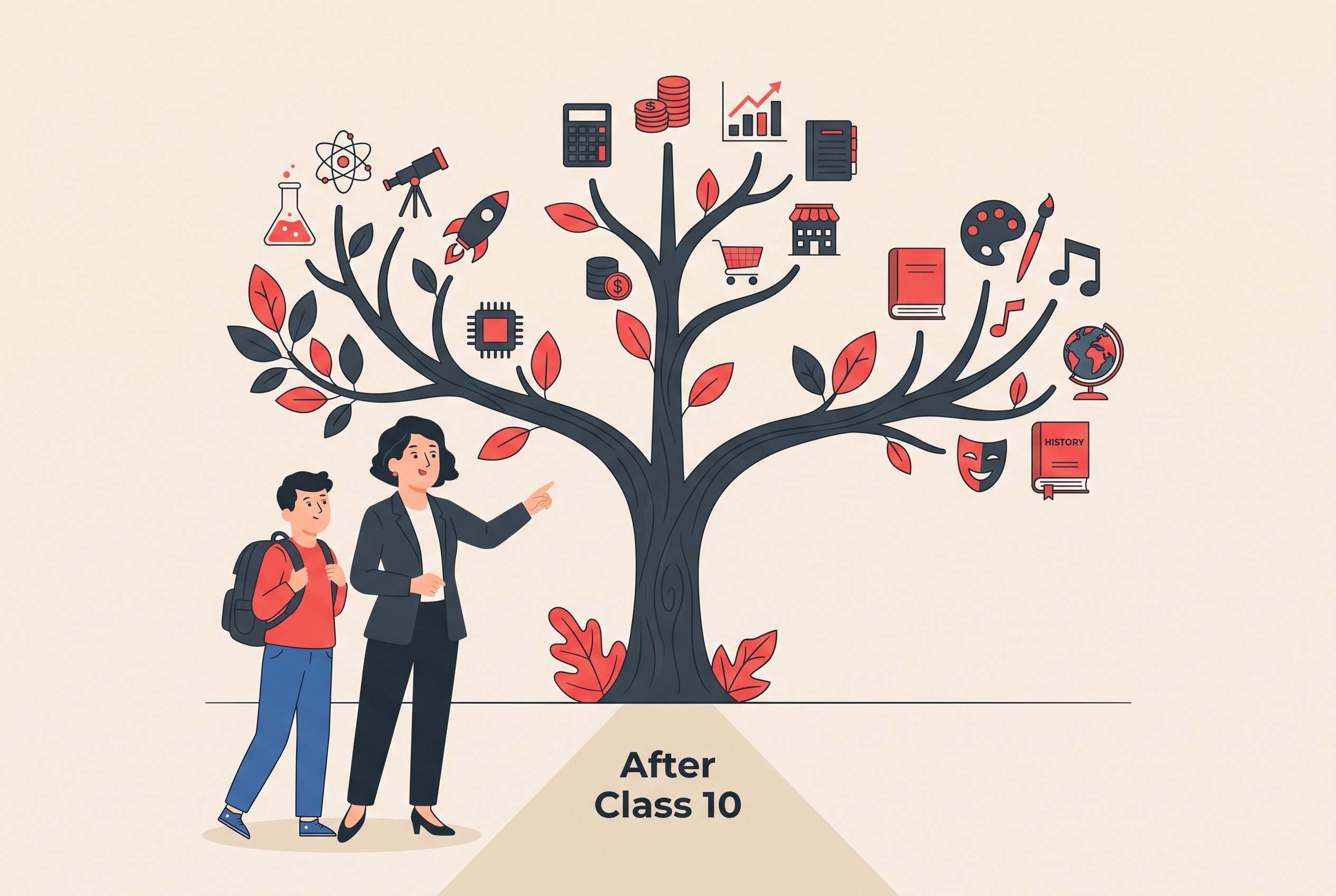
There is no universally best stream after Class 10. The better choice is the subject combination a student is prepared to engage with consistently, can reasonably study successfully, and that keeps open the higher-education routes they may realistically want to explore.
Science is not automatically superior, and Humanities is not a fallback. Stream selection after 10th is a Class 11–12 academic decision, not a permanent verdict on a child’s ability or future career. An April 2026 Indian Express education article similarly advises students to balance interests, strengths or capability, and future opportunities rather than follow popularity or external pressure. It also notes that past performance can offer useful clues, but marks alone should not dictate the choice. (Indian Express)
“Science”, “Commerce” and “Humanities” are useful broad labels, but the real decision is about the specific Class 11 combination available at your child’s school.
For example, the CBSE Senior Secondary Curriculum 2026–27 describes senior-secondary learning areas including Languages, Humanities, Mathematics, Sciences, Skill Subjects, General Studies, and Health and Physical Education. Students select languages and electives within the structure available to them.
Before discussing which stream your child “should” take, obtain the school’s written information on:
State-board, ISC/ICSE, IB and Cambridge schools may organise subjects differently. Do not assume that a combination available in one school is available in another.
These descriptions explain the kinds of subjects and work a student may encounter. They are not rigid career labels.
CBSE lists Biology, Chemistry, Physics, Computer Science and Informatics Practices within its Sciences learning area. Its curriculum describes science learning as involving scientific explanations, designing and evaluating enquiry, and interpreting data and evidence.
A Science-focused option may be worth exploring for a student who is willing to sustain scientific and quantitative work, not merely one who likes the idea of a prestigious stream. The day-to-day experience can include solving problems, understanding concepts, analysing evidence and applying ideas to real situations. (CBSE Senior Secondary Curriculum 2026–27)
CBSE’s business- and commerce-based electives include Business Studies, Accountancy, Entrepreneurship, Economics and related subjects. The curriculum describes these subjects as developing an understanding of business disciplines and exchanges involving money, products, services and information.
A Commerce-focused option may suit a student who is interested in financial records, business systems, entrepreneurship or economics. Interest in “business” alone is not enough; the student should also be willing to practise the relevant concepts and methods consistently. (CBSE Senior Secondary Curriculum 2026–27)
CBSE lists Geography, History, Economics, Home Science, Sociology, Fine Arts and Political Science in Humanities and Social Sciences. The curriculum describes these subjects as engaging with history, culture, geography, politics, the economy, institutions and social interactions.
This route may appeal to a student who enjoys reading, writing arguments, interpreting information, discussing public issues, and understanding people and society. It is not a less demanding option; the kind of effort required may simply differ from that required by a Science-focused combination. (CBSE Senior Secondary Curriculum 2026–27)
Remember that subjects do not always belong exclusively to one stream. Mathematics is a separate CBSE learning area, and Economics appears both among Humanities and Social Sciences and among business- and commerce-based electives. Check the school’s actual combination rather than relying on a stream label. (CBSE Senior Secondary Curriculum 2026–27)
Ask your child to write down:
Use Class 10 results as one signal of current preparation. Discuss the results with the student and, where useful, with relevant teachers. A mark sheet can identify areas where the student has foundations to build on, but it should not become an identity or a final career recommendation.
A student with strong marks may still dislike the daily work of a particular combination. Another student may be interested in a subject but need a realistic plan to strengthen its foundations. Both facts matter.
Over two weekends, let your child try representative Class 11 work from each serious option. For example:
The aim is not to judge whether the student gets everything right on the first attempt. Ask after each activity:
“Was this difficult but interesting, or was it only draining?”
Also ask a subject teacher to comment on the completed work. A teacher can often distinguish between a temporary gap in preparation and a deeper mismatch with the type of work involved. The trial should inform a conversation, not function as an entrance test designed by the family.
List three possible degree or career directions and verify the current official eligibility rules for each. At the same time, check whether the school timetable permits the subjects needed for those directions.
Do not assume that every degree accepts every subject combination. However, do not reject a route based only on a common myth either.
For the CLAT 2027 undergraduate programme, the Consortium of NLUs states that candidates need to have passed Class 12 or an equivalent examination with at least 45% marks generally, or 40% for candidates belonging to SC/ST/PwD categories. The published eligibility does not prescribe a Class 11 stream.
That does not mean every law-related course or institution has identical rules. It means families should verify the relevant official eligibility instead of assuming that only Humanities students can pursue law.
The ICAI New Scheme FAQ, updated on 27 September 2024, says that a student may register for the Foundation course after passing Class 10. The Foundation papers are Accounting, Business Laws, Quantitative Aptitude and Business Economics. The first Foundation attempt is after appearing for the Class 12 examination.
A student should still consider whether the subjects and workload suit them. The point is that Commerce is not the only possible starting point by rule.
Admission and examination requirements can change. Families considering engineering, medicine, architecture or another regulated route should check the newest official bulletin before dropping a relevant subject. The JEE Main 2026 bulletin and NEET-UG 2026 bulletin are separate official examination documents with separate eligibility and test rules.
Let the student explain the final choice in their own words. Record:
The review is an opportunity to notice adjustment or support needs early. It is not a promise that the school will permit a stream or subject change.
Riya enjoys Biology but dislikes Physics problem-solving. She is strong in English, Economics and debating, and is curious about psychology, public health and law. Her parents initially prefer Science because they believe it “keeps options open.”
The family checks the school’s subject combinations and finds a Humanities option with Economics and Psychology, but no Biology. They list plausible future routes. The CLAT 2027 eligibility rules are based on Class 12 results and do not prescribe a Class 11 stream, so law remains open through Humanities. If Riya wants a medical route, the family must check the current official requirements before ruling Science in or out.
Riya tries sample work, speaks with relevant teachers and chooses the option whose day-to-day work she is more prepared to sustain.
The lesson is not “Humanities is better.” It is: choose using verified constraints and fit, rather than prestige or assumption.
For each proposed subject combination, ask the family to score the following factors from 1 to 5. Use the result to identify gaps and start a discussion, not to produce a supposedly precise answer.
For instance, a combination may score highly for future flexibility but poorly for genuine curiosity. That is a reason to investigate further, not proof that the combination is wrong. This scorecard is a conversation aid, not a psychometric assessment.
The process is in a healthy place when:
If you want a structured aid for this conversation, GPaths is our suite of career assessments at GIDE.AI. It looks at a student's interests, aptitude, strengths, skills and extracurricular inputs and suggests subject and academic pathways, and our counsellors then talk the results through with the student and family. Treat it as one input to the decision, alongside the steps above.
Take the GPaths career assessment to get a shortlist of careers and courses to explore.
Subscribe Now
Test names [SAT, IELTS, AP, ACT] are trademarks of respective owners. GIDE.AI is not affiliated.