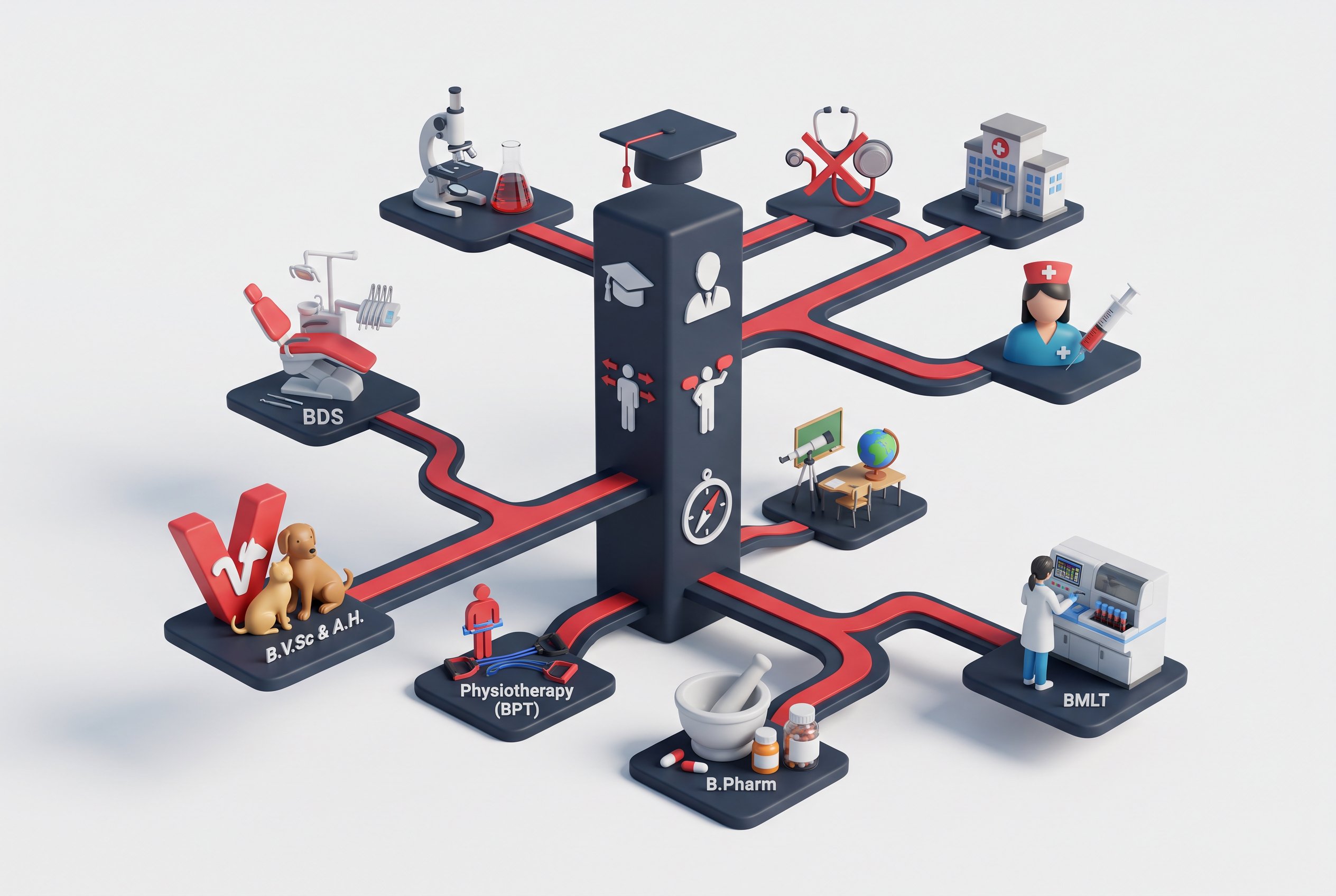
Physics, Chemistry and Biology (PCB) in Class 12 do not lead to only one profession. MBBS is one option, but students can also explore nursing, allied healthcare, pharmacy, life sciences, agriculture, food technology, veterinary science, rehabilitation and related fields. The right choice depends on the kind of work you want to do: care for patients, study medicines, operate diagnostic technology, work with biological samples, develop food and agriculture systems, treat animals, or support rehabilitation and disability services. This guide explains important courses after 12th PCB and offers a practical way to shortlist them.
Admission rules can vary by programme, college, state and quota. Do not assume that every PCB course follows the same entrance-exam route.
Two 2026–27 examples:
- For the Veterinary Council of India’s 15% All India Quota for BVSc & AH, candidates must qualify NEET-UG 2026 and meet the stated Class 12 subject and marks requirements. The bulletin specifies this route for the 2026–27 counselling cycle. Veterinary Council of India bulletin
- For agriculture and allied bachelor’s admissions through ICAR, there is no direct nomination without qualifying in CUET (ICAR-UG)-2026. The ICAR bulletin covers the 2026–27 admission session. ICAR CUET (ICAR-UG)-2026 bulletin
For every other course, check the current prospectus for the exact programme, institution, state and quota before applying.
Nursing is a patient-facing route for students who are interested in direct care and healthcare services. The Indian Nursing Council circular states a baseline eligibility requirement for B.Sc Nursing of 10+2 Science with Physics, Chemistry, Biology and English, with 45% aggregate marks. It also states that the minimum age is 17 years by 31 December of the year of admission. Treat this as the INC-stated baseline and check the current prospectus of each institution for its selection and entrance process. Indian Nursing Council eligibility circular
Allied healthcare offers different kinds of work around diagnosis, treatment and patient support. The National Commission for Allied and Healthcare Professions (NCAHP) lists categories such as:
The NCAHP Act provides a framework covering education standards, recognised qualifications, registers and institutional assessment. Before paying fees, verify the course’s university affiliation, current approval or recognition status, clinical-training arrangement and any registration requirements. NCAHP Act, 2021 NCAHP recognised categories
B.Pharm may suit students who are interested in medicines, chemistry, biology, formulation, quality systems and pharmaceutical practice. It is broader than assuming that pharmacy means only working in a retail outlet.
Under the Pharmacy Council of India’s admission rules, students may enter B.Pharm after 10+2 with English and Physics, Chemistry, Mathematics and/or Biology as subjects. The programme runs for eight semesters, or four academic years. Pharmacy Council of India B.Pharm rules and syllabus
The PCI curriculum includes subjects such as:
Use this curriculum as a starting point for comparison. Inspect the syllabus, laboratory work, practice school and project requirements of the specific college rather than choosing only by the course title.
Students who enjoy biology but prefer laboratory, research or technology-oriented learning can explore biotechnology, microbiology, biochemistry, genetics, biomedical science and bioinformatics. For a particular role, check the relevant requirements with the institution and applicable regulator.
When comparing life-science degrees, look for:
The University Grants Commission’s undergraduate curriculum framework supports multidisciplinary structures, flexible course choices, research internships and study areas including genomic studies, biotechnology and neuroscience. It also describes opportunities for students to engage with practical learning through internships and research work. UGC Curriculum and Credit Framework for Undergraduate Programmes
Agriculture and allied sciences allow students to apply biology beyond hospitals. For the 2026–27 session, ICAR’s CUET (ICAR-UG) bulletin lists 13 four-year bachelor’s programmes, including:
The list also includes Community Science, Sericulture, Agribusiness Management and Agricultural Engineering. Eligibility subjects and seat details can vary by university, so check the relevant counselling information and institution. ICAR CUET (ICAR-UG)-2026 bulletin
ICAR’s Sixth Deans’ Committee report emphasises experiential learning, skill orientation, internships, flexible study structures and updated areas such as digital and precision agriculture. Compare how a particular university implements these features instead of assuming that every college offers the same practical exposure. ICAR Sixth Deans’ Committee report
BVSc & AH is a separate animal-health route for students who want to study veterinary medicine. For the VCI 15% All India Quota in 2026–27, the stated requirements include qualifying NEET-UG 2026, studying the required Class 12 subjects and meeting the specified marks criteria. The degree lasts five and a half years, including a compulsory one-year internship. Veterinary Council of India bulletin
Psychology-related study should be approached carefully. A bachelor’s degree with “psychology” in its title should not automatically be presented as a qualification for clinical practice. The NCAHP category list includes psychologists, while noting that clinical psychologists for persons with disabilities are covered under the Rehabilitation Council of India (RCI). NCAHP recognised categories
RCI’s listed rehabilitation categories include clinical psychologists, audiologists and speech therapists, special teachers, rehabilitation psychologists, rehabilitation social workers, prosthetists and orthotists, among others. RCI states that qualifications from institutions not recognised by it are not valid for employment or practice in rehabilitation. Its registration guidance also says that professionals need a recognised rehabilitation qualification and active Central Rehabilitation Register enrolment to practise as rehabilitation professionals or personnel in India. RCI recognised institutions guidance RCI registration norms
The key check is therefore not just the course name. Verify the exact recognised qualification and the institution’s current RCI recognition before enrolling.
Use these filters to compare three or four realistic options rather than collecting a long, unranked list.
Hypothetical example: A student enjoys biology and chemistry but does not want continuous bedside care. They compare B.Pharm, B.Tech Food Technology and B.Sc Biotechnology. They then inspect each institution’s eligibility, syllabus, laboratories, internship structure and recognition status before applying, not just its marketing claims.
Before submitting applications:
At GIDE.AI, our GPaths assessment is a career exploration assessment that covers more than 15 pathways beyond MBBS, and our counsellors then help the family turn the results into a shortlist to research. Take it as a starting point for exploration: it does not predict admission or employment outcomes.
Take the GPaths career assessment to get a shortlist of careers and courses to explore.
Subscribe Now
Test names [SAT, IELTS, AP, ACT] are trademarks of respective owners. GIDE.AI is not affiliated.